Most people hear "Blue Hole" in Belize and picture the famous sinkhole out in the Caribbean, the one you need a boat or a light aircraft to see. Blue Hole National Park Belize is the other one: a deep sapphire pool in the forest beside the Hummingbird Highway, fed by an underground river, cool enough to make you gasp when you step in. It shares a park with St Herman's Cave, one of the few caves in the country you can walk into without booking a full-day tour. Together they make the easiest worthwhile stop between Belmopan and Dangriga, and they are far simpler to reach with your own vehicle than with anything else.
Where is Blue Hole National Park and what is actually there?
The park sits in the Cayo District, along the Hummingbird Highway south-east of Belmopan, in the limestone hills that separate the Belize Valley from the coastal plain. It is managed by the Belize Audubon Society and has two separate roadside entrances a short distance apart, connected by forest trail.
The things you come for are:
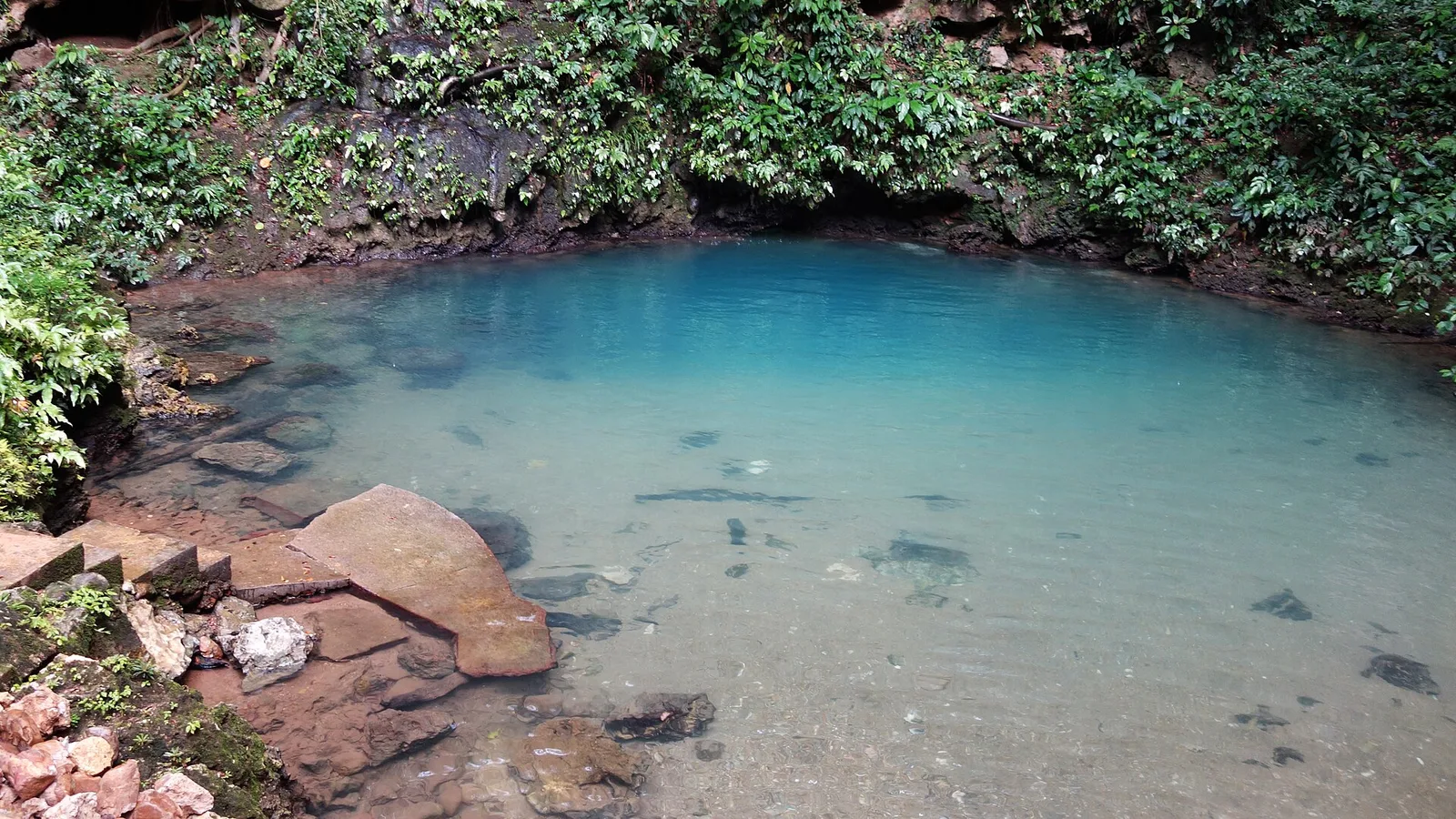
- The inland blue hole — a collapsed karst sinkhole filled by the Sibun River system as it surfaces briefly before disappearing underground again. Stone steps lead down from the car park to a small platform and the water.
- St Herman's Cave — a large, dramatic cave mouth reached by a stairway cut into the hillside, with an interior section open to visitors.
- The Hummingbird Loop and connecting trails — forest walking through broadleaf jungle, good for birds early in the morning.
- A visitor centre and ranger station at the St Herman's entrance, with toilets and changing facilities.
Entrance fees are collected at the gate, and the rate and opening hours are set by the Audubon Society rather than by us, so check the current numbers locally or by phone before you go. The same goes for guides: the deeper sections of St Herman's Cave require a licensed guide, and arrangements for that are made at the park, not in advance through a rental company.
The swim
The pool is small, perhaps the size of a village swimming hole, ringed by rock and hanging vine. The water comes out of the hillside cold and leaves again through a cave mouth on the far side, which is what keeps it clear and that particular deep blue-green colour.
After rain it can run cloudy and brown, and after heavy rain the level rises and the park may close the swimming area for safety. That is normal and worth planning around: if you are driving in September or October after a few wet days, have a second stop in mind.
There is a wooden deck and steps. Bring footwear you do not mind getting wet, because the rock is slick. Do not jump from the edges.
What is St Herman's Cave like to walk?
The approach is a stairway down a steep, shaded hillside into a sinkhole, ending at a cave mouth big enough to swallow a house. A stream runs out of it. Inside, the floor is uneven river rock and shallow water, and you will be scrambling over boulders rather than strolling a walkway.
It is not a technical cave, but it is genuinely dark and genuinely wet. People turn an ankle here every year. Go slowly, use both hands, and accept that your shoes are going to be soaked.
This is a different experience from the better-known ceremonial caves elsewhere in Cayo. There is no long river swim and no full-day commitment. An hour at the cave and an hour at the pool, plus a walk between them, is a realistic half-day.
Plan for
- Closed-toe shoes with grip that you are happy to drown — no flip-flops
- A head torch or a decent hand torch with fresh batteries
- Swimwear and a quick-dry towel
- Insect repellent, particularly for the forest trail
- Drinking water and a snack; there is little in the way of food at the park
- Small Belize dollars in cash for the entrance gate
- A dry bag or plastic sack for your phone
Driving the Hummingbird Highway
The Hummingbird is the prettiest major road in Belize and, for a lot of visitors, the single best reason to have a vehicle. It climbs out of Belmopan into the Maya Mountain foothills, past citrus groves, roadside fruit stands and a succession of green limestone peaks, then drops down towards Dangriga and the sea.
It is paved for its whole length and generally in reasonable shape, though conditions shift with the season and with whatever repair work is under way. Expect tight curves, a few blind crests, speed bumps through every village, and the occasional pothole that appears overnight after rain. Drive it in daylight if you can — not because it is dangerous after dark, but because you are missing the point otherwise.
Rough timings, and they are rough: Belmopan to the park is a short run of well under an hour, and the park to Dangriga is roughly another hour depending on traffic and road work. From San Ignacio, allow something like an hour and a half to the park gate. Coming from Placencia or Hopkins, you approach from the Dangriga end.
What vehicle suits this trip?
You do not need four-wheel drive. Both entrances are directly off the paved highway with gravel car parks. What helps is ground clearance for the speed bumps and the rougher patches, decent brakes for the descents, and room to throw wet gear in the back without soaking anybody's luggage.
A mid-size SUV handles this comfortably — the 2017 Jeep Cherokee is a sensible pick for two to four people with bags, and a 2015 Jeep Compass does the job for a couple travelling light. Larger groups heading on to the coast together will want to look at the seven- and eight-seat options across the full fleet. Every rental comes with third-party insurance and unlimited mileage within Belize, so a long detour down the Hummingbird costs you nothing but fuel.
If you are still working out licences, driving rules, fuel and currency, our practical Belize travel notes cover the basics before you arrive.
Fitting it into a bigger route
The park works best as a stop rather than a destination. Three combinations that make sense:
- Belmopan to Hopkins or Dangriga — leave mid-morning, swim and cave, arrive on the coast for a late lunch.
- A day loop from San Ignacio — out along the Hummingbird, into the park, back the same way with a stop at a roadside fruit stand.
- Placencia run — break the drive north or south with a cold swim, which is more restorative than it sounds after two hours in the car.
You cannot do any of this on a bus timetable without losing most of the day. That is the honest argument for renting.
Before you go
We are a family business on Benque Viejo Road in San Ignacio, and we deliver and collect vehicles anywhere in the country, including the international airport, Belmopan, Dangriga, Hopkins and Placencia. Alongside the rentals we run towing, recovery and freight services, and we hire out tables, chairs and tents for events, which is a different sort of customer entirely but keeps the yard busy.
Questions about pickup points or what will fit your group are best answered by a person — reach us by phone or WhatsApp through our contact page.
When you are ready, send us a reservation request. There is no online payment and no booking fee; we check availability and confirm the price with you directly. Then the Hummingbird is yours.
Frequently asked questions
Is the inland Blue Hole the same as the famous Great Blue Hole?
No. The Great Blue Hole is a marine sinkhole offshore, reached by boat or small plane and usually visited on a dive or flight tour. The inland blue hole is a freshwater karst pool inside St Herman's Blue Hole National Park on the Hummingbird Highway, and you can drive right up to it. They are completely separate places.
Do I need a guide to enter St Herman's Cave?
The entrance section of the cave can normally be walked without a guide, while the deeper passages require a licensed guide arranged at the park. Rules and availability are set by the Belize Audubon Society, which manages the site, so confirm at the visitor centre on arrival. Bring your own torch either way.
Can I swim in the blue hole all year round?
Usually, but not always. Heavy rain can raise water levels and turn the pool cloudy, and the park may close the swimming area for safety. If you are travelling in the wetter months, check conditions locally and keep an alternative stop in mind.
What kind of rental vehicle do I need to reach Blue Hole National Park?
Both park entrances sit directly off the paved Hummingbird Highway, so four-wheel drive is not necessary. A standard SUV is comfortable for the winding road, the speed bumps through villages and the gravel car parks. Any of the SUVs in our fleet will handle the trip, and all rentals include third-party insurance and unlimited mileage within Belize.